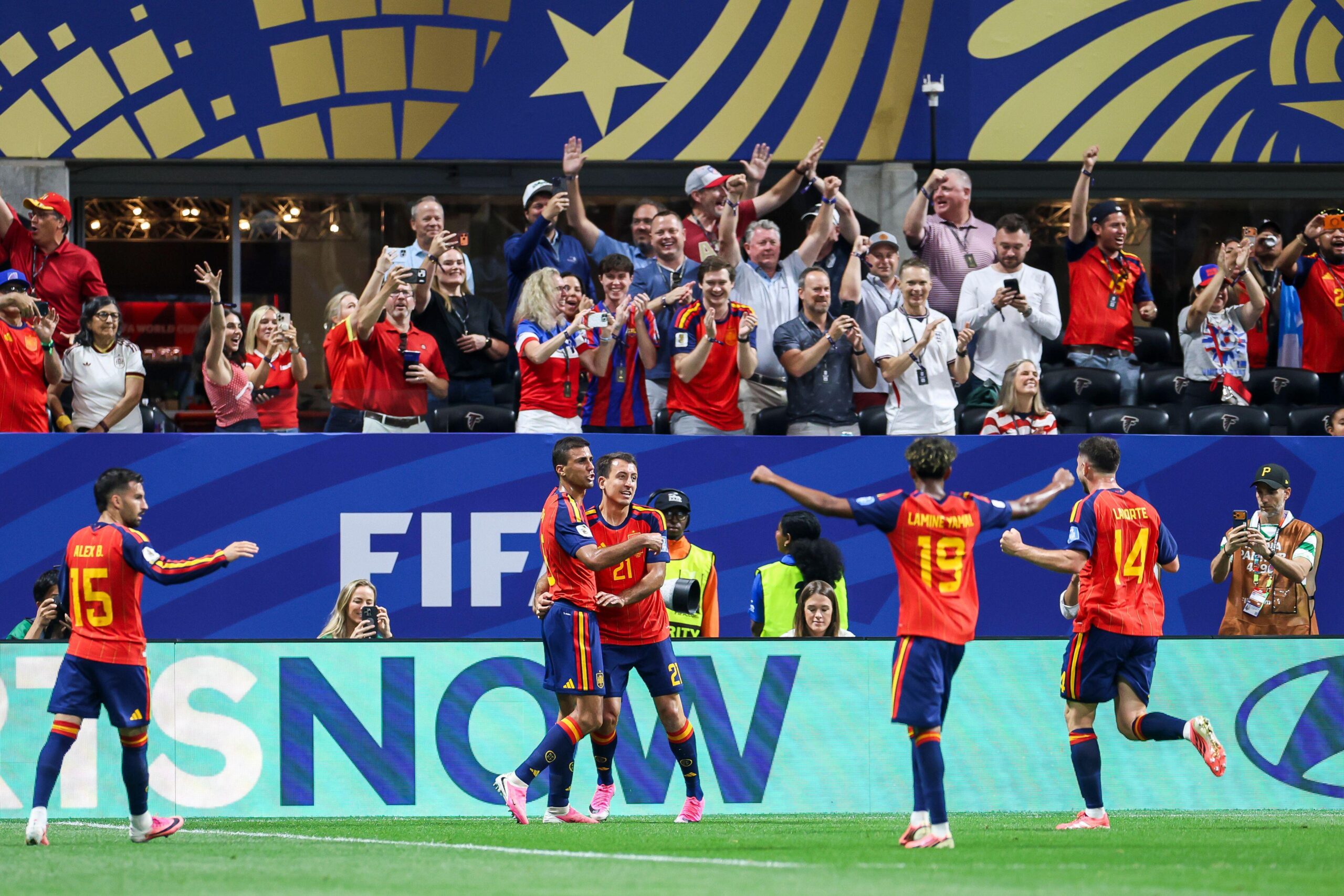

Spain’s second group match at the 2026 FIFA World Cup provided a clear response to their scoreless opening draw with Cabo Verde. On 21 June in Atlanta, Spain beat Saudi Arabia 4-0. Lamine Yamal scored in the 10th minute, Mikel Oyarzabal added goals in the 21st and 24th, and Hassan Altambakti’s own goal completed the score in the 49th minute.
FIFA’s match report supplies those details and the group-stage context. It describes Spain as having been held 0-0 by tournament debutants Cabo Verde in their first fixture, then taking control against Saudi Arabia from the opening stages. The 4-0 result did not erase the draw from the record; it changed the shape of Spain’s group campaign by giving them three points and a substantial goal difference.
Four goals in Atlanta
Spain’s first goal came from a move involving two of the match’s principal figures. Oyarzabal crossed and Yamal slid in to finish. The official report records Yamal as 18 years and 343 days old, making him the eighth-youngest goalscorer in FIFA World Cup history and Spain’s second youngest at the tournament.
Oyarzabal’s two goals followed in the space of three minutes. FIFA attributes both to Spain’s pressure after Saudi Arabia struggled to clear the ball. The third goal arrived before the first hydration break, which meant the match’s direction was established early without needing to invent broader claims about a tactical transformation.
The fourth was an own goal by Altambakti shortly after half-time. Official scorelines credit an own goal differently from a scorer’s personal total, so the distinction matters: Spain won 4-0, Yamal scored once, Oyarzabal scored twice, and Altambakti was credited with the final goal. That is more precise than loosely calling every goal a Spanish player’s finish.
Why the result mattered in Group H
FIFA’s pre-tournament Spain profile listed Cabo Verde, Saudi Arabia and Uruguay as Spain’s Group H opponents. The same page set out Spain’s schedule: Cabo Verde in Atlanta on 15 June, Saudi Arabia in Atlanta on 21 June and Uruguay in Guadalajara on 26 June.
Spain’s draw with Cabo Verde made the Saudi Arabia fixture important, but it did not put them in an immediate elimination match. The 2026 World Cup had 12 groups of four, with the top two in each group and the eight best third-placed teams moving into the Round of 32. FIFA’s format announcement explains that structure. The win therefore improved Spain’s position before the final group game while keeping qualification dependent on the complete table.
FIFA later confirmed in its Spain-Argentina final preview that Spain won the group. The team followed the Saudi Arabia result with a 1-0 win over Uruguay, then progressed through the new knockout ladder. That later outcome gives the 4-0 match a clearer place in the campaign: it was the result that followed the opening setback and helped Spain regain control of Group H.
Yamal’s contribution
Yamal’s goal was the opening score, not the only reason for the win. Oyarzabal’s brace and the own goal were equally part of the official scoreline. Yet Yamal’s age and timing make the goal a useful milestone. FIFA identifies him as Spain’s second-youngest World Cup scorer, and the match report notes that he was returning to the starting XI.
It is also important not to import records from another tournament without saying so. UEFA’s EURO 2024 record summary records that Yamal became the youngest scorer in the European Championship when Spain beat France in the semi-finals. That was a separate competition, achieved at a different age and under different record criteria. His World Cup statistic belongs to FIFA’s competition record instead.
The comparison still illustrates the unusual pace of his international career. In 2024 he won UEFA EURO and the Young Player of the Tournament award. In 2026 he was one of Spain’s teenage World Cup contributors. Those official milestones are enough; claims that he single-handedly remade Spain’s campaign would overstate a team result.
A result within a title-winning campaign
Spain went on to win the 2026 World Cup, defeating Argentina 1-0 after extra time in the final. FIFA’s final report credits Ferran Torres with the 106th-minute winner. That later success does not turn every group-stage performance into a final-level display, but it makes the Saudi Arabia match part of a broader tournament recovery and progression.
The factual retrospective is straightforward. Spain began Group H with a 0-0 draw against Cabo Verde. They then beat Saudi Arabia 4-0 in Atlanta. Yamal opened the scoring, Oyarzabal scored twice and Altambakti’s own goal completed the result. Spain later topped the group and became world champions. Each point is directly supported by FIFA’s competition reporting.
Sources
- FIFA: Spain 4-0 Saudi Arabia match report — score, scorers, goal times and Yamal’s World Cup age record.
- FIFA: All eyes on Spain in 2026 — Group H opponents and scheduled fixtures.
- FIFA: World Cup 2026 format — 48-team qualification structure.
- FIFA: Spain v Argentina final preview — Spain’s subsequent group and knockout route.
- UEFA: Yamal’s record-breaking EURO — separate EURO 2024 milestones.
- FIFA: Spain 1-0 Argentina final report — Spain’s title and Ferran Torres’s extra-time winner.
Publisher
The BW Game Hub Sports Analysis Unit is the senior sports news desk at BW Game Hub, overseeing daily sports news coverage, football market analysis and legal updates across international jurisdictions. With a background in sports journalism and market research, the unit tracks player movements, league developments and operator news to bring readers real-time, verified insights.