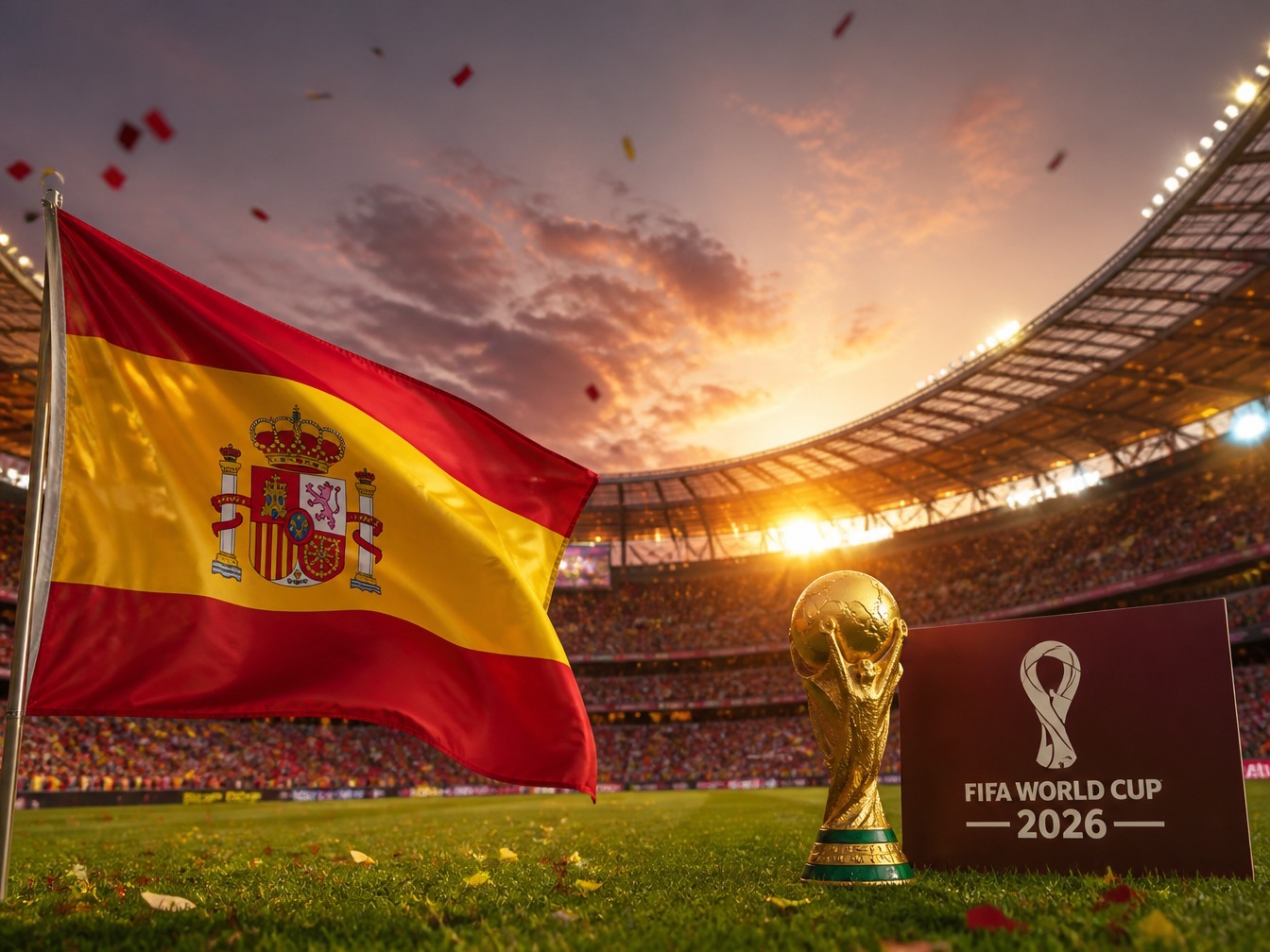

Spain did not merely remain among the favourites at the 2026 FIFA World Cup. La Roja won the tournament, defeating Argentina 1-0 after extra time at New York New Jersey Stadium on 19 July. FIFA’s final standings rank Spain first and describe a campaign in which the team conceded only one goal on the way to its second World Cup title.
Spain drew their opening game with Cabo Verde, then recovered to win the group and navigate five elimination matches. The route included a late win against Portugal, a 2-1 quarter-final over Belgium, a 2-0 semi-final win over France and an extra-time final against holders Argentina. The champions were not flawless at every stage, but repeatedly found a way to progress.
A group stage recovery
FIFA’s Spain schedule records a 0-0 draw with Cabo Verde in Spain’s opening Group H match. Spain then beat Saudi Arabia 4-0 and Uruguay 1-0 to top the group. Spain did not begin by sweeping every opponent aside; the team responded after an opening draw and built its position through the remaining group fixtures.
The expanded format then required a Round of 32 match. Spain beat Austria 3-0, a scoreline that provided the clearest knockout win of the campaign. The path tightened afterwards. Tournament champions do not need every match to look the same, and Spain’s later results show the value of adapting to games where the margin was one goal.
Portugal and Belgium: two different tests
Spain beat Portugal 1-0 in the Round of 16, with Mikel Merino scoring in the 90th minute. FIFA’s Portugal v Spain report confirms the score and the timing of the decisive goal. A late winner did not establish the championship, but it was a turning point: Portugal were eliminated and Spain reached the quarter-finals.
Spain then beat Belgium 2-1 in the quarter-finals, as recorded in FIFA’s complete Spain schedule. The one-goal margin kept the tie close, but it was a different contest from the 1-0 win over Portugal and moved Spain into the last four.
Spain’s ability to survive these matches gave the team a semi-final against France. At that point, the tournament’s most difficult opponents were no longer theoretical possibilities. The results had made them the actual route to the trophy.
The semi-final against France
Spain defeated France 2-0 at Dallas Stadium. FIFA’s match report identifies Mikel Oyarzabal’s penalty in the 22nd minute and Pedro Porro’s goal in the 58th. FIFA describes Spain as limiting France’s opportunities while taking their own.
This was Spain’s standout victory of the late tournament because it paired a two-goal margin with control against a team that had won all of its previous World Cup matches. FIFA’s De la Fuente feature connects Spain’s progress to its established possession-based identity and records the coach’s emphasis on his group’s collective work. Spain beat France 2-0 and reached the final while remaining committed to that approach.
The final against Argentina
Argentina were the holders, and the final required extra time. FIFA’s final standings say Spain beat Argentina 1-0 after extra time and had 20 attempts to Argentina’s two across 120 minutes. FIFA’s championship review identifies Ferran Torres as the scorer, finishing in the 106th minute after a Nico Williams lay-off.
The final was not a routine win. Spain controlled long periods but faced an Argentine defence that kept the score at 0-0 into extra time. The winning goal arrived only after 105 minutes. Spain then had to protect the lead through the remaining minutes. That sequence is why “road to glory” is an accurate retrospective angle: the title came through a combination of clear wins, late goals and an extra-time finish rather than through an uninterrupted procession.
What Spain’s title shows
Spain’s 2026 victory was the country’s second men’s World Cup title, following 2010. The campaign also delivered a notable defensive record: FIFA says La Roja conceded once over the tournament. Spain’s route combined a group-stage reset after Cabo Verde, a 3-0 Round of 32 win, a 1-0 victory over Portugal, a 2-1 quarter-final against Belgium, a 2-0 semi-final and a 1-0 extra-time final.
Spain were tested in different ways and kept advancing. The group, knockout and final results show how La Roja built their second World Cup title.
The final record
Spain won World Cup 2026, beating Argentina 1-0 after extra time in the final. Their knockout route was Austria, Portugal, Belgium, France and Argentina. The 2026 title gave La Roja a second World Cup and completed a campaign that required both emphatic wins and narrow victories.
Sources
- FIFA: Final tournament standings — Spain’s title, final score and tournament ranking.
- FIFA: Spain’s World Cup schedule — complete fixture and score route.
- FIFA: France 0-2 Spain match report — semi-final result and scorers.
- FIFA: Spain men and women make history — knockout route and final winning goal.
- FIFA: Portugal 0-1 Spain match report — Round of 16 score and Merino’s late winner.
- FIFA: De la Fuente stayed true to Spain’s idea — the coach’s account of Spain’s approach in the semi-final.
Publisher
The BW Game Hub Sports Analysis Unit is the senior sports news desk at BW Game Hub, overseeing daily sports news coverage, football market analysis and legal updates across international jurisdictions. With a background in sports journalism and market research, the unit tracks player movements, league developments and operator news to bring readers real-time, verified insights.