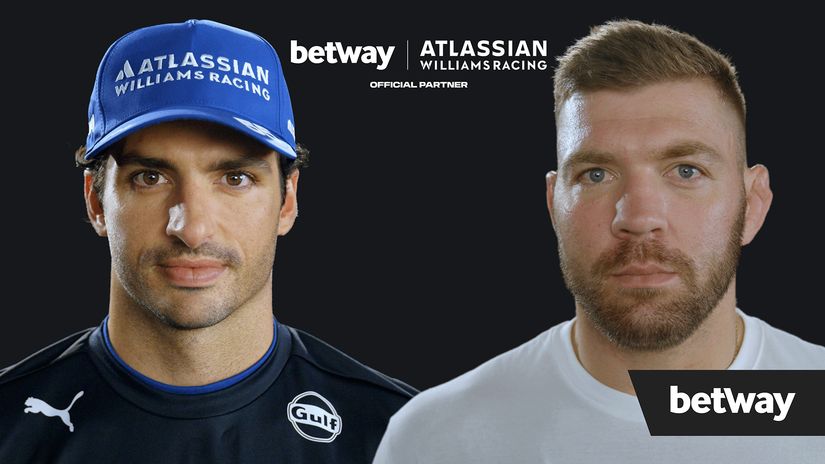
Feel the Gs: Carlos Sainz and Dricus du Plessis Trade Sporting Worlds
A shifting 20-kg steering load and a punishing neck test reveal what Formula 1 and mixed martial arts ask of the body.
The wheel turns left, but the weight inside it keeps moving. Dricus du Plessis plants his feet as Carlos Sainz calls the next section: hold the corner, change direction, relax on the straight. Then the load rolls again.
The former UFC middleweight champion knows physical pressure, but this feels unfamiliar. Straps pull at his wrists, sand shifts inside the steering rig and the onboard footage demands another turn before his arms recover.
When the attempt ends, he admits that it was harder than expected. That reaction captures the point of the Feel the Gs episode. Each athlete has prepared his body for a different job.
What Is Feel the Gs Testing?
Formula 1 demands precision under heavy braking and through rapid changes of direction. Du Plessis combines punches, takedowns, clinches and submissions while an opponent tries to break his balance or control his movement.
The episode brings those demands together. Sainz explains the equipment, while du Plessis supplies the power and competitiveness. Presenter Alex Haddon oversees the contests until he is persuaded to attempt one.
Two tasks isolate different demands: controlling the arms against an unstable load and using the neck to resist force. They expose each athlete to unfamiliar movement.
Why Are G-Forces So Demanding in Formula 1?
G-force describes acceleration relative to gravity. In an F1 car, it can load a driver sideways through a corner or forwards under braking, making the head, helmet and limbs feel considerably heavier.
Formula 1 reports that drivers regularly experience sustained forces of around 4–5g through high-speed corners, with peaks approaching 6g at certain circuits. Drivers manage those forces while steering accurately, reading the track and processing information over the radio.
Bracing is not enough. The arms must remain responsive for a slide correction or sudden change of direction. The neck supports the head so the eyes stay fixed on the road. Strength, control and concentration work together.
How Does the 20-Kg Steering Challenge Work?
The “Steering Stone” looks awkward before it begins. A steel ball in the steering column holds 20 kg of sand. As du Plessis turns the wheel, the sand moves and changes where the load is felt. Straps pull his wrists in opposite directions.
Onboard footage sets the pace while Sainz talks him through the lap. A long corner demands a steady hold; a quick change of direction sends the weight back across the rig. The straights offer only brief chances to release his grip.
Du Plessis has the raw power to move the wheel. The difficulty lies in controlling it smoothly when the shifting weight wants to continue elsewhere. Sainz knows where the simulated lap offers a breath and where the load will build, giving the exercise a recognisable racing rhythm.
Power begins the movement. Timing and fine control complete it.
Why Does Neck Strength Matter to Both Athletes?
The second station, “Neck Pull”, places a band around the athlete’s head and connects it to measured resistance. The direction of the pull changes to imitate some of the loads felt around a lap.
For Sainz, neck conditioning helps keep the head supported through repeated braking zones and corners. It also helps a driver maintain steady vision and place the car precisely despite the forces acting on the body.
Du Plessis trains the same muscle group for a different purpose. Fighters must maintain posture during striking and resist attempts to move or control the head in grappling exchanges. The muscles are shared; the sporting demands are not.
Du Plessis attacks the test with little interest in saving energy. Sainz considers what it would mean to repeat the effort throughout a Grand Prix. Attention then turns to Haddon, who strains against the resistance before deciding that he has felt enough.
The laughter keeps the sequence light, but this is specialised training equipment. It should not be copied without suitable coaching and supervision.
What Do Sainz and Du Plessis Learn?
The episode works because neither athlete dismisses the other’s discipline. Du Plessis jokes about the steering machine, then discovers how much coordination it requires. Sainz is impressed by the fighter’s commitment and becomes more curious about the preparation behind an MMA performance.
Their competitiveness produces teasing, but respect shapes the ending. The tests do not establish which sport is tougher. They show how specific elite conditioning becomes: a body prepared for five-minute rounds still meets unfamiliar problems when a load behaves like an F1 corner.
Customers who meet the relevant requirements can explore Betway’s Formula 1 section for the races and markets presently listed. What appears on the page can differ by event, jurisdiction, location and account eligibility.
Betting has a cost and should remain a form of leisure rather than a way to make money. It is intended only for adults permitted to participate under the rules in their location. Keep your spending within a limit chosen in advance, avoid trying to win back losses and use the available responsible-gambling tools whenever needed.
Publisher
The BW Game Hub Sports Analysis Unit is the senior sports news desk at BW Game Hub, overseeing daily sports news coverage, football market analysis and legal updates across international jurisdictions. With a background in sports journalism and market research, the unit tracks player movements, league developments and operator news to bring readers real-time, verified insights.