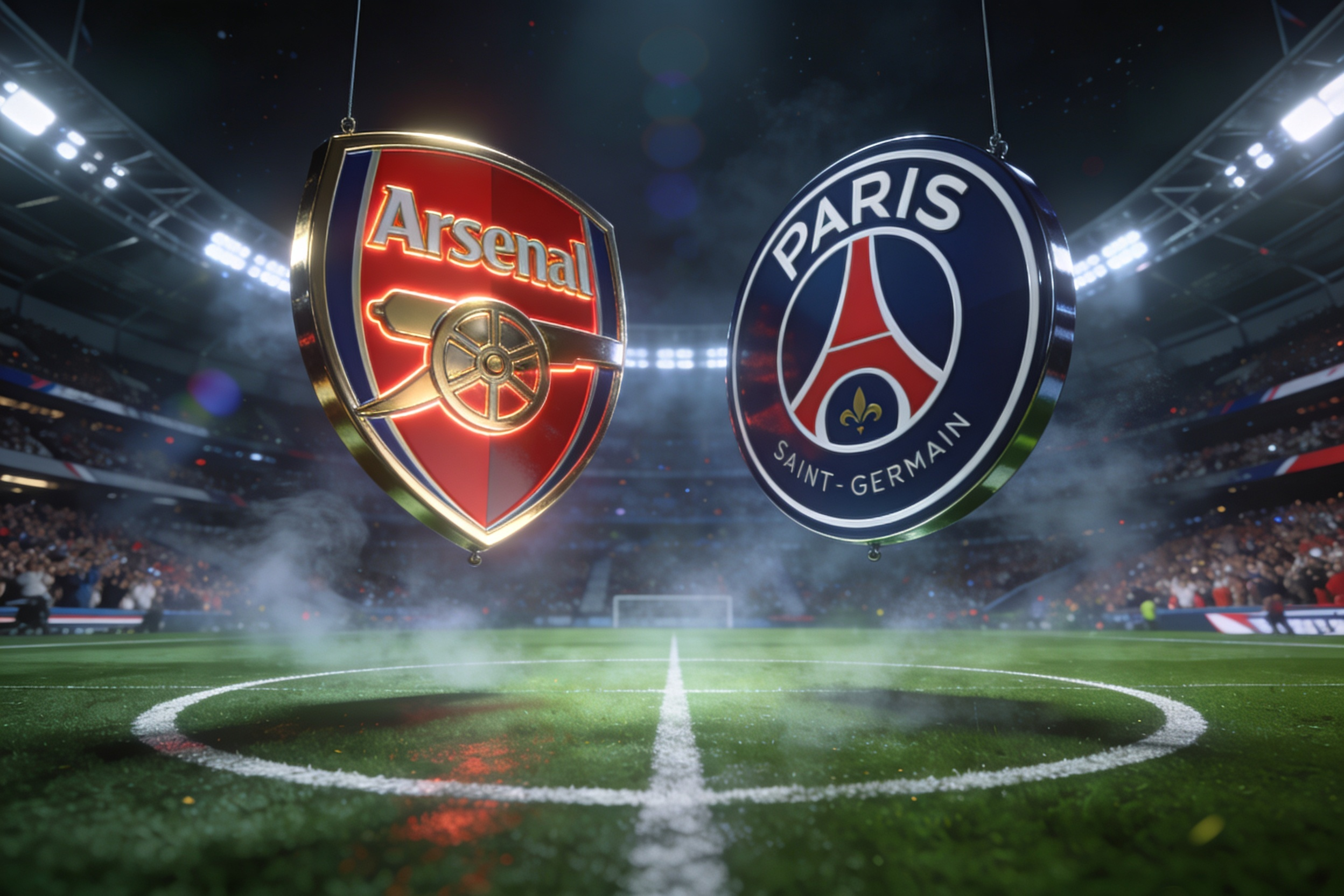

The 2026 UEFA Champions League final between Paris Saint-Germain and Arsenal was not settled by the pre-match question of who held the edge. It was settled by an early Arsenal goal, a Paris equaliser, a long period in which neither team found another breakthrough, and a penalty shoot-out. Paris won 4-3 on penalties after a 1-1 draw following extra time at Budapest’s Puskás Aréna, becoming back-to-back European champions.
UEFA’s final match report supplies the core sequence. Kai Havertz put Arsenal ahead in the sixth minute. Ousmane Dembélé equalised from the penalty spot in the 65th. The score stayed level through extra time, and Paris converted four of five kicks to Arsenal’s three. The result should therefore be described as a narrow final resolved under shoot-out conditions, not as proof that either side had an overwhelming tactical advantage.
Arsenal’s fast start and Paris’s response
Arsenal began with the kind of moment that changes a final’s shape. UEFA records Leandro Trossard pressing a clearance before Havertz finished from a tight angle. An early lead gave Arsenal something real to protect, but it also required the team to defend for a long period against a Paris side that had come to Budapest as holders.
The equaliser was equally important because it reset the match. Dembélé scored a penalty in the 65th minute, and UEFA’s technical review identifies the goal as part of Paris’s response after Arsenal’s opening pressure. At 1-1, neither club could rely on its original match plan. The final became a test of recovery, game management and concentration rather than an uncomplicated contest of possession figures or reputation.
That is why claims of a single decisive tactical battle need care. The official record provides individual events and a result; it does not justify inventing broad tactical certainties. What it does show is that Arsenal created an opening and Paris found a route back. Both sides then had moments without a second goal arriving before the shoot-out.
Fine margins in an even final
UEFA’s technical analysis describes Paris’s win as being decided by the finest of margins. It notes that Arsenal pushed the defending champions hard and that the final was the first in the competition since 2016 to require a shoot-out. This is useful context because a penalty shoot-out has a different evidential weight from a multi-goal win: it decides the champion, but it does not erase the closeness of the preceding match.
The shoot-out itself was decisive. Paris scored four times from five attempts. Arsenal scored three. UEFA lists Eberechi Eze, Nuno Mendes and Gabriel among the players who failed to convert. That sequence made Paris champions, while the 1-1 result after 120 minutes remains the scoreline that describes the football played before penalties.
The distinction matters for readers assessing the two teams. Arsenal did not lose the final by being outscored in normal or extra time. Paris did not need a late open-play winner to retain their crown. The final was level, then Paris were more accurate from the spot. Those statements are both true and much more precise than a retrospective prediction framed as certainty.
Paris’s route to a second consecutive title
Paris had already survived a demanding semi-final against Bayern München, winning 6-5 on aggregate. UEFA’s champions review lists their full knockout route: 5-4 on aggregate against Monaco in the play-off, 8-2 against Chelsea in the Round of 16, 4-0 against Liverpool in the quarter-finals and 6-5 against Bayern in the semi-finals. UEFA’s complete competition results provide the round-by-round record. The final added another narrow result, with the trophy decided by penalties.
That campaign context helps explain why the title should not be reduced to one night in Budapest. Paris combined comfortable aggregate wins with close elimination ties, and their final was another close contest. The reliable conclusion is not that a particular system guarantees success. It is that Paris repeatedly advanced, then handled the final shoot-out more effectively than Arsenal.
What Arsenal’s final means
Arsenal reached their first Champions League final since 2006 after beating Atlético de Madrid 2-1 on aggregate. UEFA notes that they completed the competition unbeaten apart from the shoot-out that ended the final. This was a strong European campaign and a painful final outcome, but it was not a title. The official record awards the trophy to Paris.
The final’s enduring story is therefore simple. Arsenal struck first. Paris equalised. Neither side won the match in extra time. Paris won the shoot-out and retained the Champions League. That replaces a prediction with the evidence the final actually supplied.
Sources
- UEFA: Paris retain the Champions League — final goals, shoot-out and title outcome.
- UEFA: Technical analysis of Paris v Arsenal — match context and fine-margin analysis.
- UEFA: Paris’s 2025/26 champions review — Paris’s route through the competition.
- UEFA: 2025/26 Champions League results — final and semi-final results.
Publisher
The BW Game Hub Sports Analysis Unit is the senior sports news desk at BW Game Hub, overseeing daily sports news coverage, football market analysis and legal updates across international jurisdictions. With a background in sports journalism and market research, the unit tracks player movements, league developments and operator news to bring readers real-time, verified insights.